“Where is your creativity, your patience, your kindness — where is yourself? Who are you? Find that wonderful person again.”
The Crisis
of Attention
We are living inside a slow emergency. Not one of fire or flood, but of erosion — the quiet, daily wearing away of who we are.
There is a crisis of creativity happening right now, and it is not because people have stopped being creative. It is because we have filled every available inch of silence with noise. Not metaphorical noise — real, physical, relentless noise. The car door slammed without thought. The motorcycle with its engine tuned for maximum aggression for no reason other than to announce its own existence. The neighbour's leaf blower, greeting every morning like a liturgy of self-absorption. The air conditioning unit that has never been serviced, growling and rattling through the wall of someone else's bedroom.
These are not small annoyances. They are, collectively, an act of violence against the commons we share. Because noise is not neutral. It lives inside the body. It raises cortisol, compresses creative thought, shortens the fuse between patience and rage. And slowly, without noticing, we become what surrounds us.
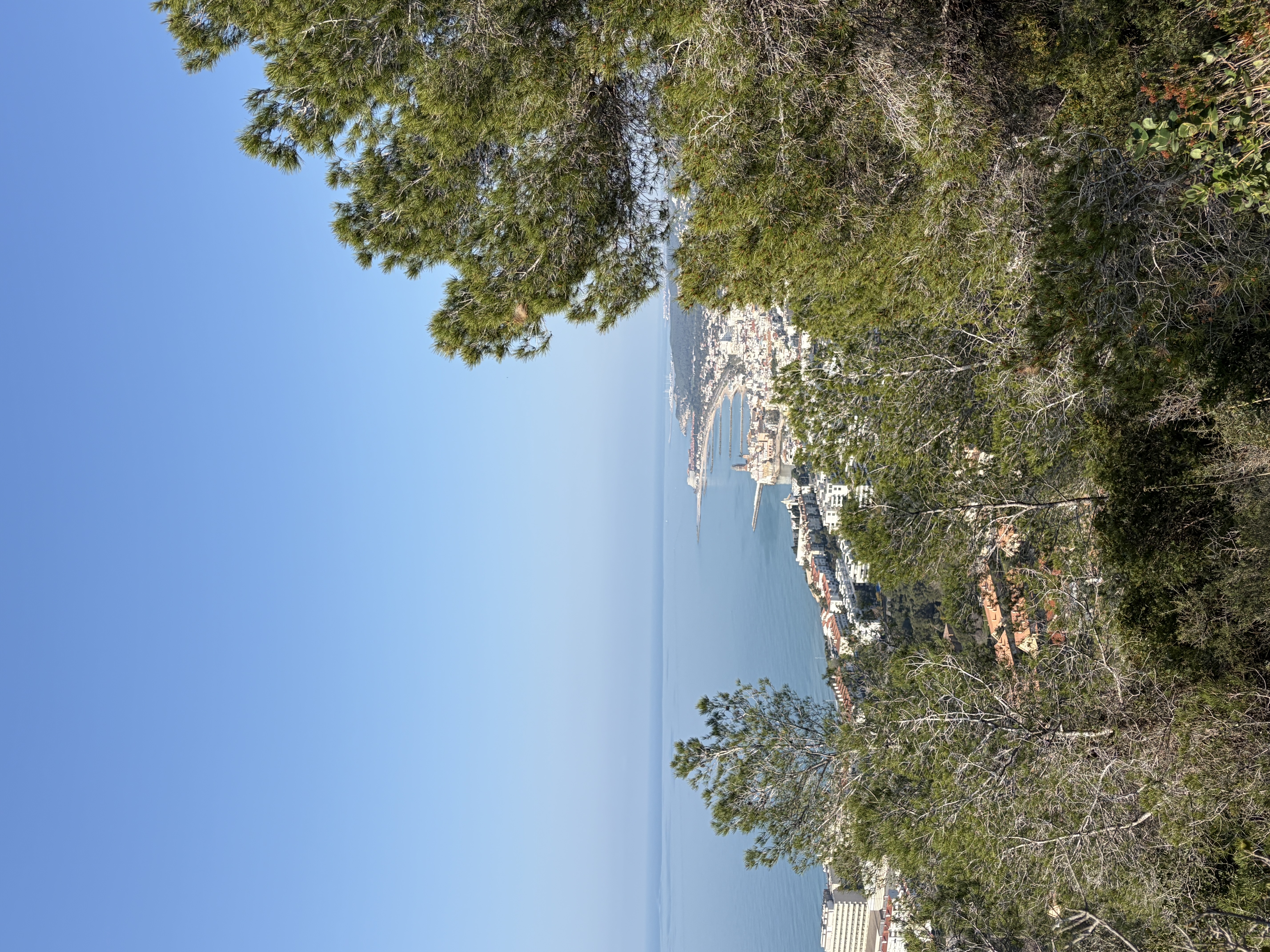
The view over Sitges from Mirador de Levantina — where the walk begins, and the city falls into its proper perspective · © Ronei, 2026
The Digital
Siege
But the noise is not only acoustic. We are besieged by information — most of it unsolicited, much of it toxic, all of it demanding an immediate response.
Emails. Calls. WhatsApp messages that arrive with the implicit demand that you answer within minutes, or you are impolite, unprofessional, a bad family member. The thousand WhatsApp groups you never asked to join, whose exit you cannot make without consequence — someone will be offended, someone will speak badly of you, the social cost of silence exceeds the cost of enduring.
The neighbour whose rooftop lights illuminate the night like an airport runway, stealing the darkness from everyone around them. The supermarket, the restaurant, the public office — places where increasingly the default expression on a human face is one of contained fury, as though the simple act of existing in public has become an exhausting negotiation.
We have built systems — administrative, digital, social — that treat the individual as an inconvenience. Public administrations that handle citizens with a kind of institutional contempt: the bureaucratic power play disguised as procedure. You accept it, or you receive a fine. The complaint goes nowhere.
The Architecture of Daily Overwhelm
- —Unmaintained AC units rattling through walls
- —Motorcycles tuned for maximum noise
- —Daily leaf blowers without consideration
- —Rooftop lights blocking neighbours’ views
- —WhatsApp groups you never requested
- —The obligation to respond immediately
- —Public administration contempt
- —Angry faces in supermarkets and cafés
- —Information you never chose to receive
- —Social media’s relentless performance
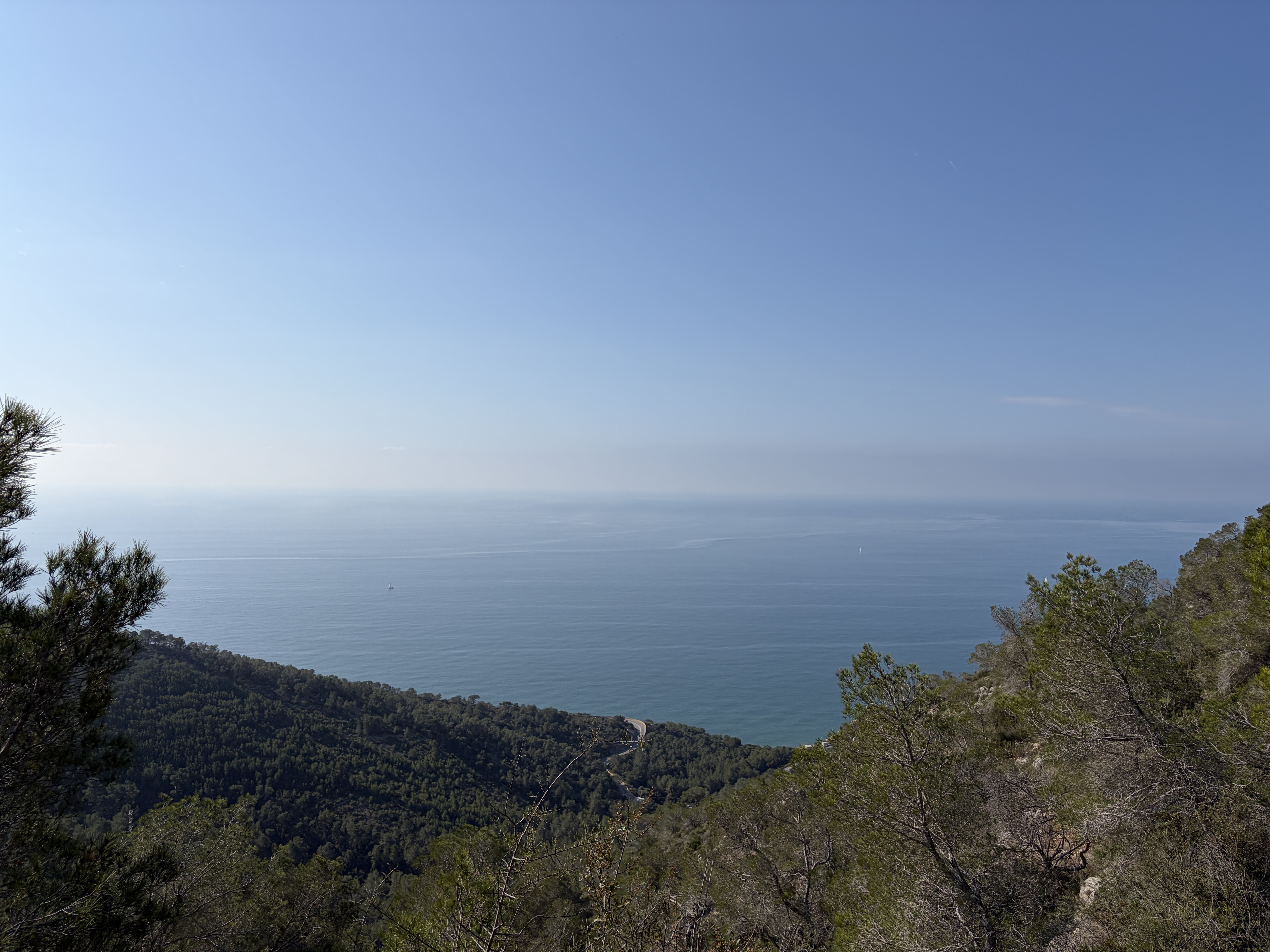
Midway through the Garraf Natural Park — the Mediterranean spreads to the horizon and the noise of the world below cannot reach you · © Ronei, 2026
“We lose health. We lose creativity. We lose confidence. We lose patience. We become the same anger, the same bad face as the others — without ever choosing to.”
On the cost of collective numbnessWhat We
Lose
The most devastating consequence of this environment is not stress. It is the loss of self.
You wake one day and discover you don't know where your creativity went. Where your patience lives. You find yourself responding to rudeness with rudeness, to urgency with urgency, to noise with noise. Not because you chose this — but because it is what you absorbed, day after day, until it became your default frequency.
We are shaped by our environments with far greater force than most of us accept. The brain does not cleanly separate the world outside from the world within. It integrates, adapts, mirrors. When the outside world is chaotic, contemptuous, relentless and loud — the inside world becomes the same. And then we wonder why we cannot create, why we cannot think clearly, why we snap at the people we love, why we feel simultaneously exhausted and numb.
This is not weakness. This is physiology. This is the entirely predictable result of a world that has optimised aggressively for output and convenience at the expense of dignity, quiet, and the right of every person to a moment of undisturbed peace in their own home, on their own street, in their own mind.
The Walk
That Broke
the Limit
This was not a planned essay. It was provoked by a morning — a Sunday in March — when something inside me reached its limit.
I walked from the Mirador de Levantina, at the end of Avinguda de la Trinitat in Sitges, up through the pines of the Garraf Natural Park, 2.5 kilometres to the Ermita de la Trinitat. The path is not dramatic. It does not require special equipment or extraordinary fitness. It requires only that you show up and walk. And what it gives back is extraordinary precisely because it asks so little: your presence, your feet, the sound of sea breeze moving through the pines.
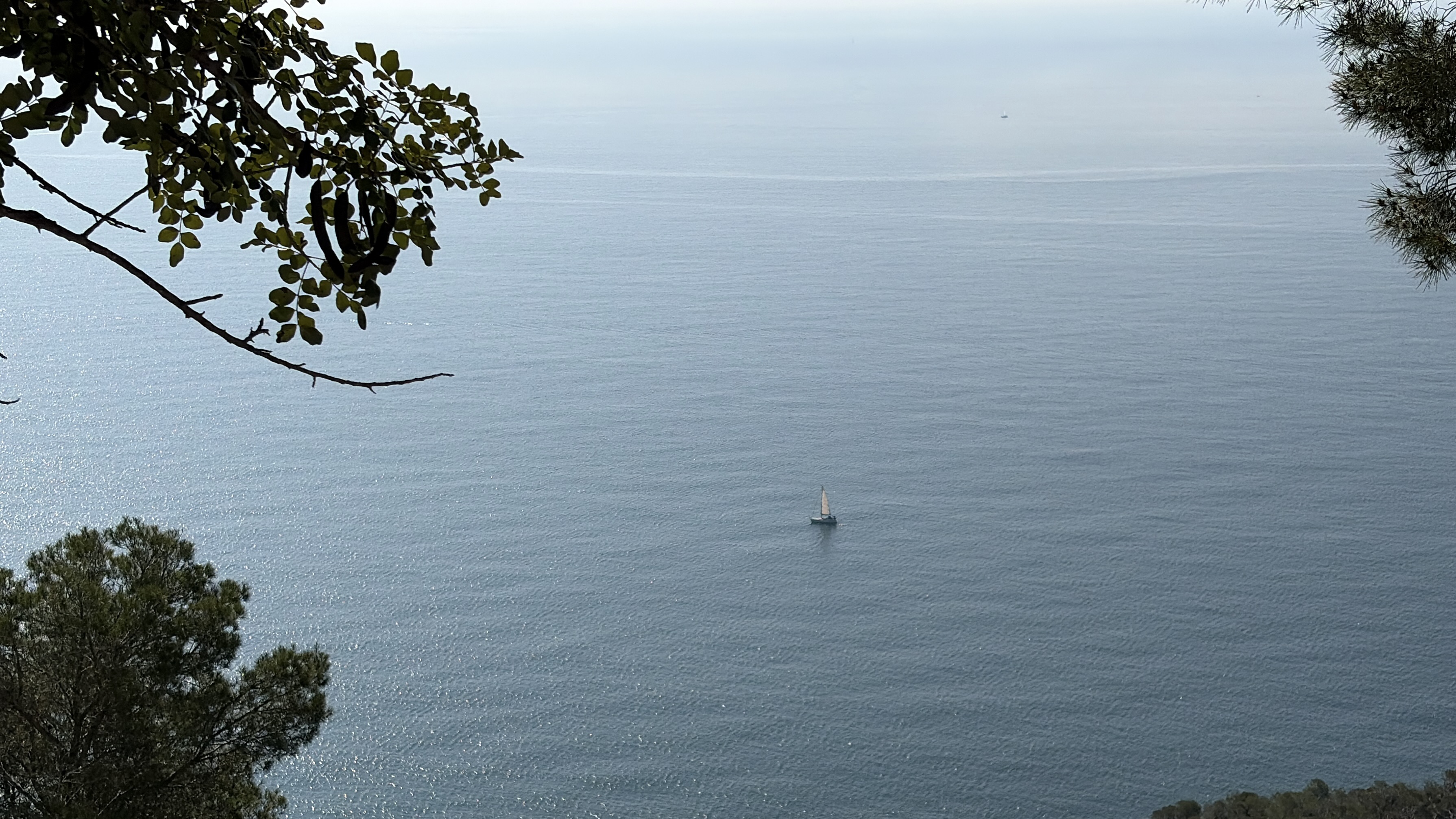
That sound. The breeze touching the canopy, carrying the scent of the Mediterranean up through the hillside. Sailboats far below on water as still as thought. The forest doing what forests have always done — breathing, holding, staying.
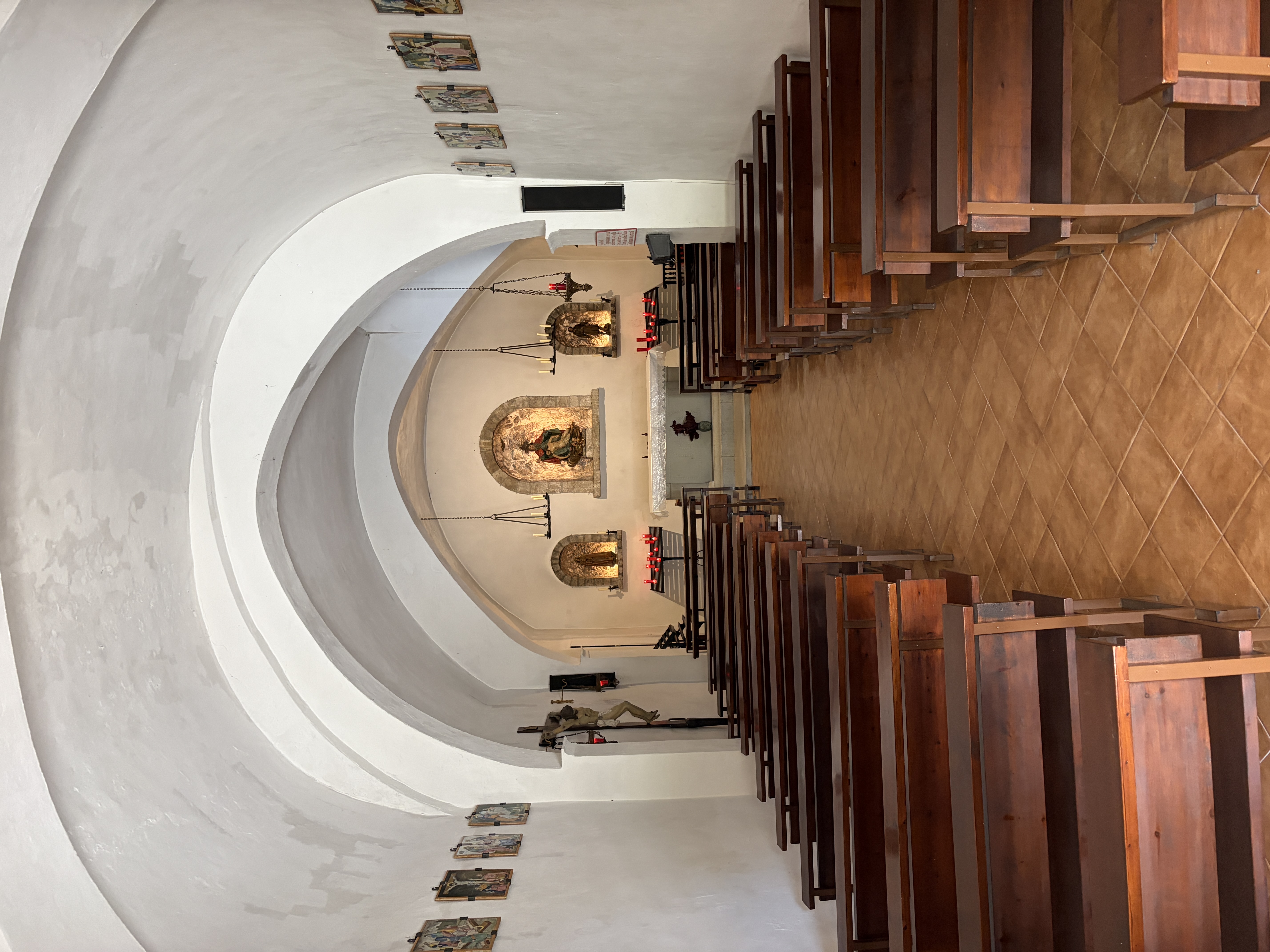
When I arrived at the Ermita de la Trinitat — a small chapel that opens only on alternate Sundays — it was empty. Stone arches, whitewashed walls, red candles, silence. And standing there, something gave way. Tears came — not from sadness but from an exhausted gratitude: the recognition of how rarely we give ourselves permission to simply stop. And how desperately we need it.
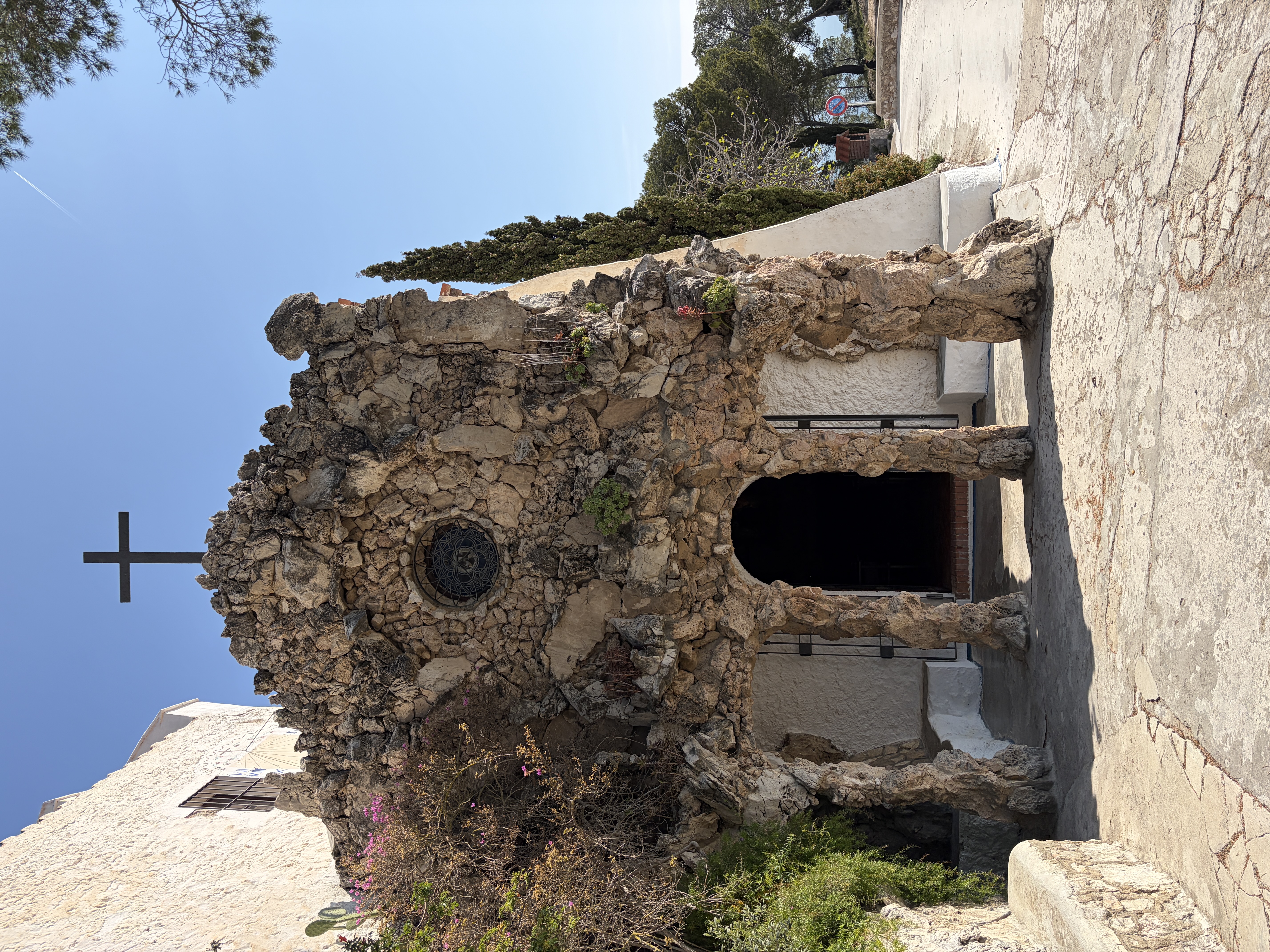
The Ermita de la Trinitat — a chapel of vernacular religious architecture first documented in 1375, rebuilt in the late 18th century, still standing above the sea · © Ronei, 2026
Left: the vaulted interior — the same stone arches and red candles that have received pilgrims since 1375 · Right: a sailing boat crosses the still Mediterranean far below, seen from the ermita terrace · © Ronei, 2026
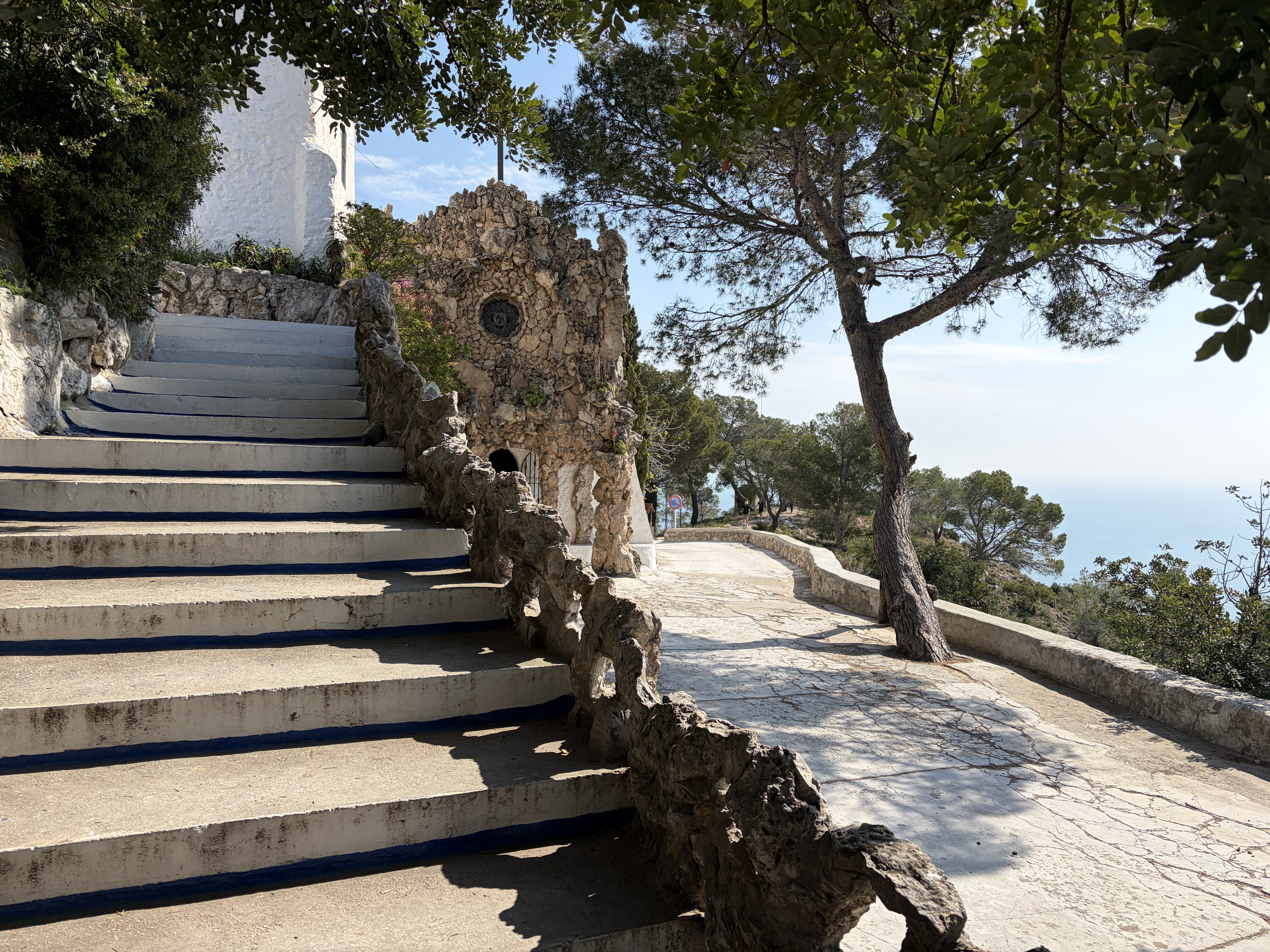
From the ermita's terrace — on a clear day the view extends from the Llobregat delta to the north all the way south to the Cap de Salou · © Ronei, 2026
What We
Can Choose
The invitation is not to escape permanently. It is to choose deliberately — and to make those choices often, and without guilt.
We cannot always change the neighbour. We cannot always silence the machine. But we can stop treating our attention as an obligation we owe to everyone who demands it. We can be selective about what information we allow to enter us. We can leave groups that cost us more than they give. We can stop eating in places where the staff look at us with contempt, stop shopping where no one greets us as a human, stop enduring what we don't have to endure.
We can choose to walk. To sail. To travel. To sit in an empty chapel on a hillside and let the silence do its work. The location matters less than the deliberation. Not as an occasional luxury, but as a practice — a deliberate, regular act of reclamation.
We can also choose to be the people who do not add noise to others' lives. Who maintain their machines. Who dim their lights. Who understand that community is not an abstract value — it is the lived reality of people whose wellbeing intersects with ours every single day, whether we acknowledge it or not.
Consciousness is not passive. It is a choice we make in every small action. The engine we don't rev. The blower we put away earlier. The message we wait to send. The space we leave for someone else's silence. And when you find yourself back in the noise — as you will, because we all do — the practice is not to achieve permanent peace, but to remember: you have already felt what silence feels like. You know the way back.
· · ·“Enjoy yourself.
Enjoy life.
Be respectful. Be kind.”
This was written from what I see every day — in my work, in my life, and in a 6-kilometre walk on a Sunday morning above the sea at Sitges, where the pines know how to be quiet, and reminded me that I once did too.
Levantina → Ermita de la Trinitat · Sitges, Catalonia · March 2026
🌲
Practical Guide · Walk This Yourself
Levantina → Ermita de la Trinitat
2.5km from Levantina
~60minutes one way
★★☆Moderate — for everyone
~6km return trip
Getting to the startDrive to the Mirador de la Levantina, located at the very end of Avinguda de la Trinitat in Sitges — the road literally ends at the viewpoint. There is parking here. Leave your car at the mirador and begin the trail uphill into the Garraf Natural Park from there. The path is well-worn and begins immediately.
Alternatively, you can drive directly via the Carretera de les Costes (C-246a), reaching the ermita at km 3.5. This is the road option if you prefer to visit without the full hike — the chapel is signposted from the road.
About the trailThe path alternates between steeper rocky sections and gentler pine-shaded stretches. Some parts are narrow and uneven underfoot — but nothing that requires technical experience. The trail is suitable for anyone with reasonable fitness and proper footwear. Difficulty varies: some parts are more demanding, others easy and open. The reward at every turn is the view.
The trail passes through the Parc del Garraf — a protected natural park of Mediterranean scrubland and pine forest, where the light changes with the trees and the sea is never fully absent from view.
- 1Park at the Mirador de la Levantina at the end of Avinguda de la Trinitat. Before you begin, look back over Sitges — the whole town laid out below puts the walk in the right frame of mind.
- 2Follow the path uphill into the park from the mirador. The first section is the steepest. Take your time. There is no rush here; this is the whole point.
- 3At roughly the halfway point the canopy opens and the full Mediterranean panorama appears to the south and east. Stop. Breathe. This is what you came for.
- 4Continue uphill through the pines until you reach the ermita at the summit of the Punta de la Ferrosa — the whitewashed chapel with its stone stairway is unmistakable against the sky.
- 5The ermita opens every alternate Sunday. If you find it unlocked, step inside. The silence has a particular quality inside those stone walls. Stay as long as you need.
What to bring: A bottle of water — always. A good pair of hiking shoes with grip, not trainers. A phone and smartwatch for navigation and security, especially if you walk alone — signal is intermittent through the park. Sun protection is important from spring onwards — the upper sections are exposed. The walk is accessible to most people of average fitness; the key is to go at your own pace.
About the Ermita · Historical NotesErmita de la Trinitat
Sitges · Garraf · Catalunya · First documented 1375The Ermita de la Trinitat is one of Sitges's oldest and most quietly significant heritage buildings — a small chapel of vernacular religious architecture perched at the summit of the Punta de la Ferrosa headland, to the east of the town. It is listed in the Inventari del Patrimoni Arquitectònic de Catalunya and protected as a Bé Cultural d'Interès Local — a Cultural Asset of Local Interest.
The building's history reaches back to at least 1375, when documents already record the presence of hermits living here. A local tradition holds that the chapel was built on the spot where a cross bearing the image of the Holy Trinity was discovered — hence its name. The practice of hermit-keepers continued for centuries, making this a living sanctuary rather than a purely ceremonial one.
The current structure is largely the product of a late 18th-century reconstruction, undertaken after the original roof collapsed and the building had to be rebuilt from scratch — and expanded in the process. What stands today preserves that essential modesty: a single nave with three barrel-vaulted arches, three stone niches sheltering religious figures, Stations of the Cross mounted along the whitewashed walls, and red votive candles that seem never entirely to go out.
The location is extraordinary. The terrace offers views that sweep from the mouth of the Llobregat river to the north, all the way south to the Cap de Salou on clear days — an unbroken panorama of the Catalan coast. On a calm Sunday morning, with the sea below and the pines around you, it is easy to understand why someone placed a sanctuary here. And why people keep returning.
LocationCarretera C-246a, km 3.5
08870 Sitges, Barcelona
Contact633 67 99 70
Opening hoursEvery alternate Sunday
— check locally for current schedule
Heritage statusInventari del Patrimoni Arquitectònic de Catalunya
Registre 11986 · Bé Cultural d’Interès Local
First documented1375 (with hermits already in residence)
Current structureLate 18th century
(rebuilt after original roof collapse)
SettingSummit of Punta de la Ferrosa
Parc del Garraf · Comarca del Garraf
ViewsLlobregat delta → Cap de Salou
on clear days
R
About the author
Ronei
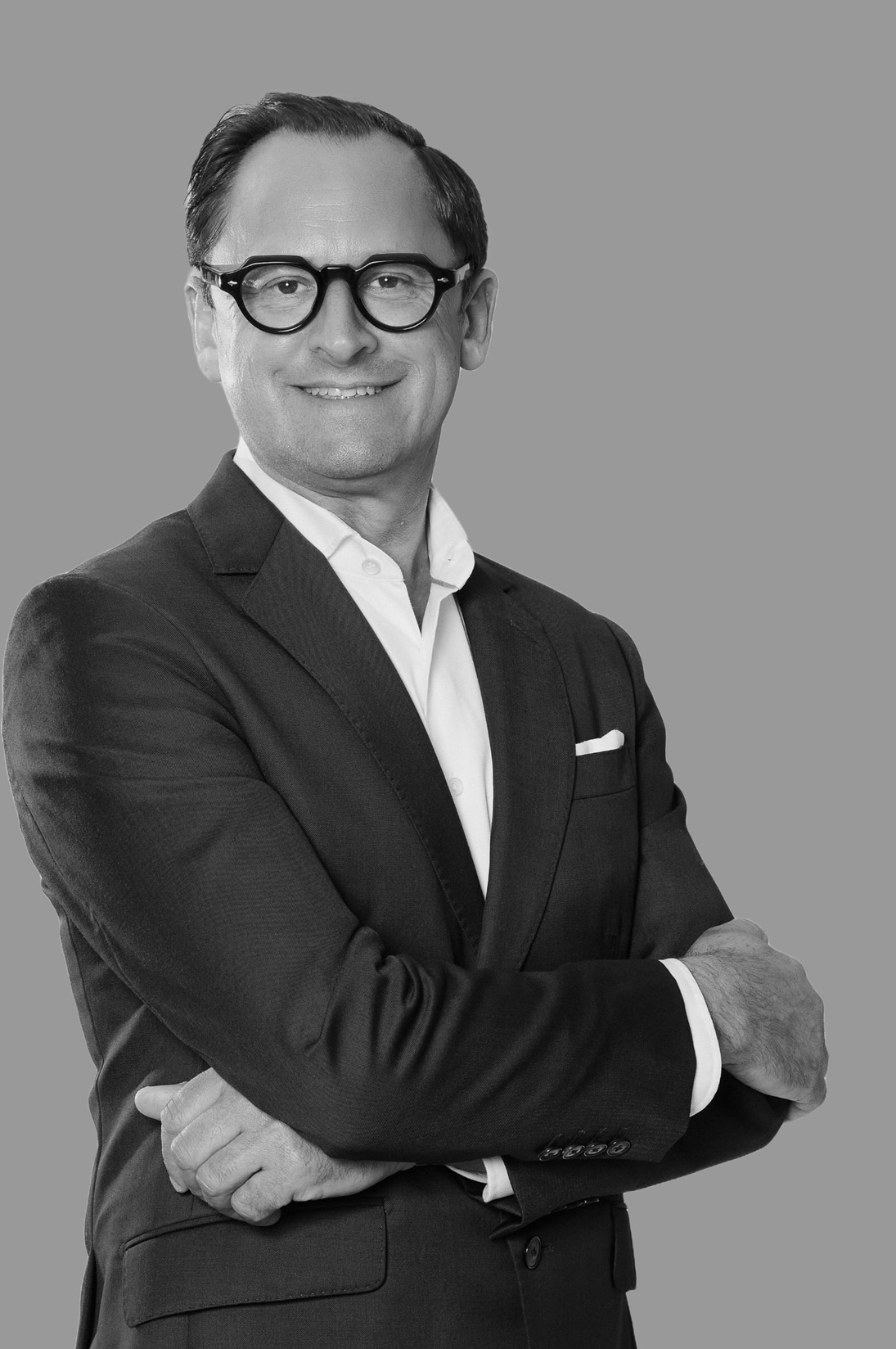
Brazilian-born and based between Sitges and The Cotswolds, Ronei is an entrepreneur, father and husband. He has worked in real estate since 1999 and founded Yes Delivery — Barcelona's first premium restaurant delivery service — which he built from scratch and sold in 2012. He is the founder of VERV ONE, a real estate consultancy rebranded in 2024, operating across Sitges, Barcelona, Girona and The Cotswolds. A life spent building businesses across languages, cultures and time zones — from late-night delivery logistics to complex renovation projects and the demands of international clients and family life — has given him a first-hand understanding of what modern professional life does to the person living it. He walks the trails above Sitges often. This essay emerged from one of those walks — on a Sunday in March 2026 when the accumulated weight of the world's noise became the precise thing he needed to walk away from.
© 2026 Ronei. All rights reserved. All photographs in this article were taken by the author on Sunday, 22 March 2026 on the trail between the Mirador de Levantina and the Ermita de la Trinitat, Sitges, Catalonia, Spain. No image, text, or part thereof may be reproduced, distributed, transmitted, displayed or used in any form without the explicit written permission of the author. Text and photography: © Ronei, 2026. Historical and descriptive information on the Ermita de la Trinitat sourced from the Inventari del Patrimoni Arquitectònic de Catalunya (Generalitat de Catalunya, Registre 11986) and the Direcció General del Patrimoni Cultural.